A method for integral cohomology of posets
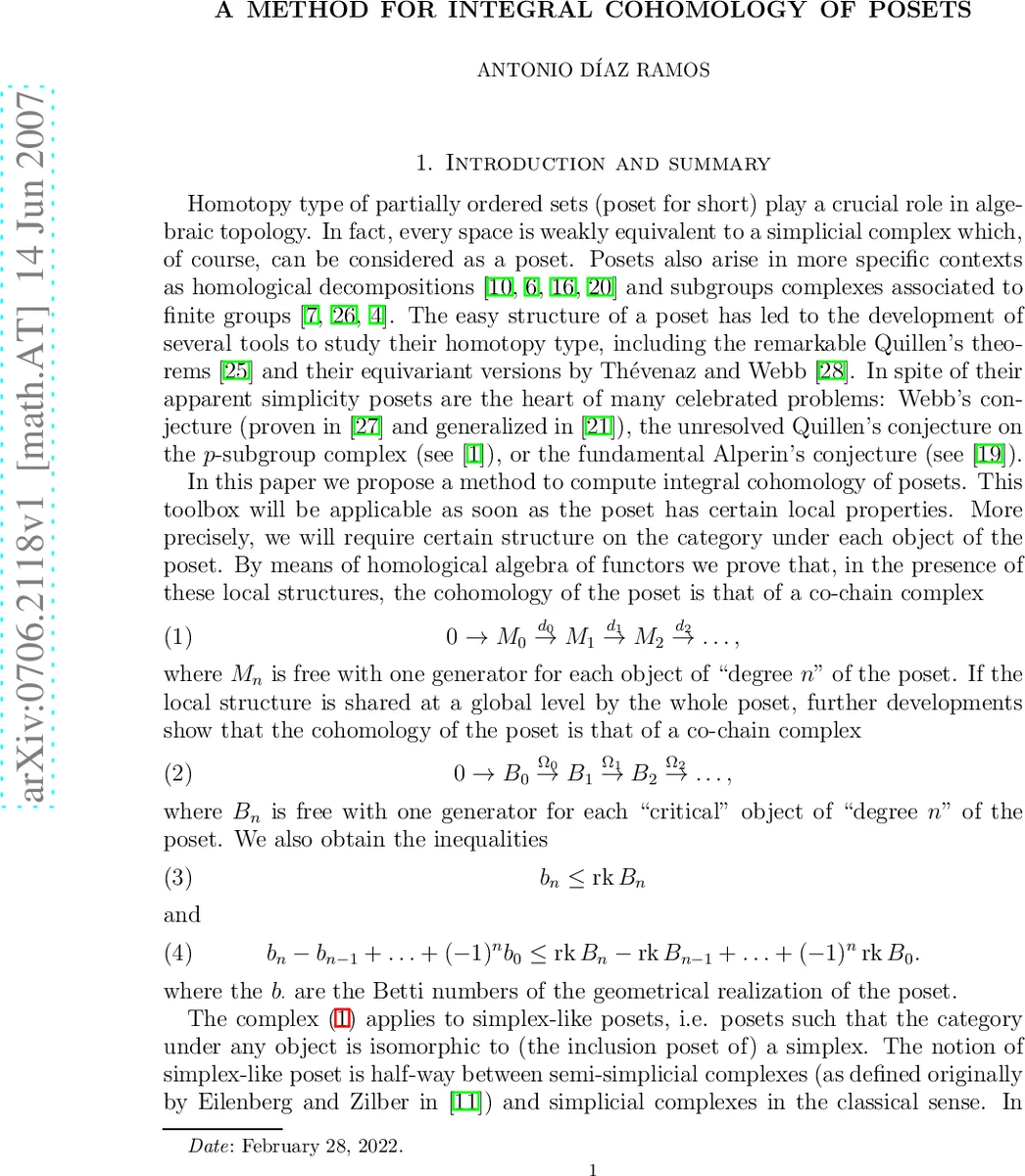
We present a method to compute integral cohomology of posets. This toolbox is applicable as soon as the sub-posets under each object possess certain structure. This is the case for simplicial complexes and simplex-like posets. The method is based on homological algebra arguments in the category of functors and on a spectral sequence built upon the poset. We show its relation to discrete Morse theory. As application we give an alternative proof of Webb’s conjecture for saturated fusion systems and we compute the cohomology of Coxeter complexes for finite and infinite Coxeter groups.
💡 Research Summary
The paper introduces a systematic method for computing the integral cohomology of partially ordered sets (posets) by exploiting the algebraic structure of functor categories and a spectral sequence built from the poset itself. The authors begin by defining a graded poset, i.e., a poset equipped with an integer-valued degree function deg : Ob(P) → ℤ that reverses the order (if p ≺ q then deg(p)=deg(q)+1). This grading allows one to stratify the poset into layers and to associate a free abelian group to each element of a given degree.
Cohomology with coefficients in a functor F : P → Ab is defined as the right derived functors of the inverse limit, H⁎(P;F)=lim←⁎ F. The key technical condition is that F be “n‑condensed”: F(p)=0 for deg(p)<n and Ker F(p)=0 for deg(p)>n. Under this hypothesis the authors apply a “shifting argument”: they construct a cyclic functor F′, an injective resolution Ker′ F, and a quotient functor G fitting into a short exact sequence 0→F→Ker′ F→G→0. Lemma 2.9 shows that if F is n‑condensed then G is (n+1)‑condensed, and the process can be iterated.
To keep the functors free (i.e., taking finitely generated free abelian groups as values) the paper introduces a local covering family J={Jₚⁿ}. For each object p and each n≤deg(p) a subset Jₚⁿ⊆(p↓P)ⁿ is chosen, satisfying two covering axioms that guarantee that the restriction maps from lim←(p↓P)⁎ F to the product over Jₚⁿ are injective and, when F is free, are pure monomorphisms. A free, n‑condensed functor F is called J‑determined if these restriction maps are pure monomorphisms for all p with deg(p)>n+1 (and pure monomorphisms for deg(p)=n+1). Proposition 3.6 proves that under these hypotheses the quotient functor G obtained from the shifting step is again free, (n+1)‑condensed, and J‑determined. Consequently, by iterating the shifting construction from the lowest degree upward, one obtains a cochain complex
0 → M₀ → M₁ → M₂ → ⋯,
where Mₙ is a free abelian group with one generator for each object of degree n. This complex computes H⁎(P;ℤ) and coincides with the usual simplicial cochain complex when the poset is the face poset of a simplicial complex.
When a global covering family exists (i.e., the local families can be chosen compatibly across the whole poset), the authors can further collapse the complex to a Morse‑type complex
0 → B₀Ω₀ → B₁Ω₁ → B₂Ω₂ → ⋯,
where Bₙ is free on the “critical” objects of degree n and Ωₙ records the covering data. The ranks of the Bₙ satisfy the weak and strong Morse inequalities
bₙ ≤ rk Bₙ, ∑{i=0}^n (−1)^{n−i} b_i ≤ ∑{i=0}^n (−1)^{n−i} rk B_i,
with bₙ the Betti numbers of |P|. Thus the construction recovers discrete Morse theory in a purely homological algebraic framework, without the need to reconstruct the space via gradient paths.
A central class of examples is the simplex‑like posets, defined by the property that for every object p the under‑category (p↓P) is isomorphic to the inclusion poset of a simplex. This class contains ordinary simplicial complexes, semi‑simplicial complexes, and many subgroup complexes arising in group theory. The authors illustrate the theory with a model of the real projective plane as a simplex‑like poset and compute its cohomology using the developed machinery.
Two major applications are presented. First, the paper gives an alternative proof of Webb’s conjecture for saturated fusion systems. In this setting the poset of non‑trivial p‑subgroups of a fusion system satisfies the local and global covering conditions, and the critical objects correspond precisely to the essential subgroups. The Morse‑type complex then shows that the poset is p‑acyclic, establishing the conjecture cohomologically.
Second, the authors treat Coxeter complexes. They prove that for a finite Coxeter group the associated Coxeter complex has the integral cohomology of a sphere (hence is homotopy equivalent to S^{n−1}), while for an infinite Coxeter group the complex is contractible. The proof follows directly from the simplex‑like structure of the Coxeter complex and the global covering family, bypassing the traditional geometric arguments.
Overall, the paper provides a powerful, algebraic toolkit for computing integral cohomology of posets. By translating local combinatorial data into exact sequences of functors, it bridges discrete Morse theory, Quillen–Webb homotopy methods, and homological algebra of functor categories. The approach is both conceptually elegant and practically effective, opening new avenues for tackling long‑standing problems in group cohomology, fusion systems, and the topology of Coxeter groups.
Comments & Academic Discussion
Loading comments...
Leave a Comment