Discontinuity and Involutions on Countable Sets
For any infinite subset $X$ of the rationals and a subset $F \subseteq X$ which has no isolated points in $X$ we construct a function $f: X \to X$ such that $f(f(x))=x$ for each $x\in X$ and $F $ is the set of discontinuity points of $f$.
Authors: ** - 김성수 (Sung Soo Kim) – 한양대학교, 안산, 경기도
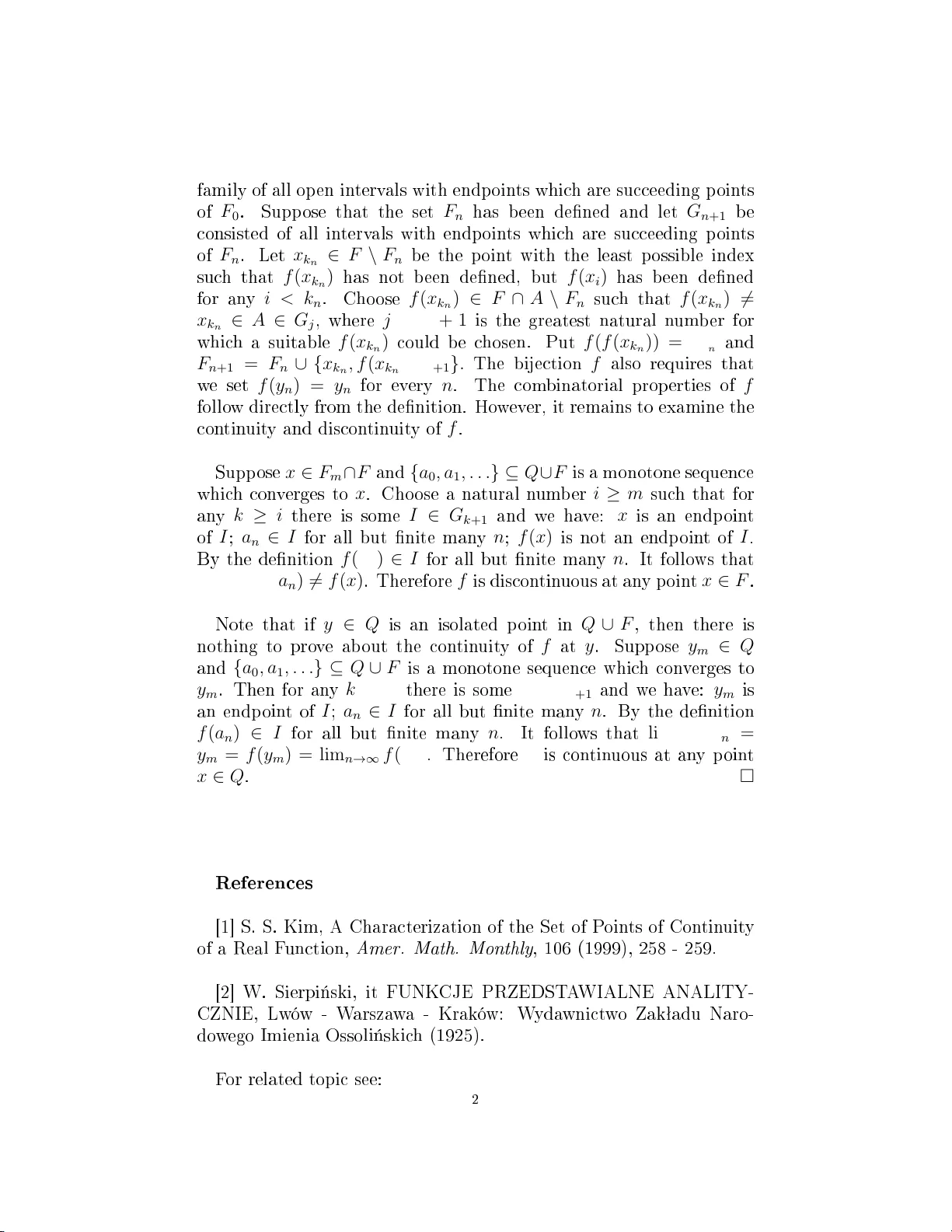
DISCONTINUITY AND INV OLUTIONS ON COUNT ABLE SETS SUNG SOO KIM AND SZYMON PLEWIK Abstra t. F or an y innite subset X of the rationals and a subset F ⊆ X whi h has no isolated p oin ts in X w e onstrut a funtion f : X → X su h that f ( f ( x )) = x for ea h x ∈ X and F is the set of dison tin uit y p oin ts of f . In the literature one nds a few algorithms that an pro due an y giv en subset of the rationals as the set of dison tin uit y p oin ts of a funtion. Probably W aªa w Sierpi«ski [2℄ w as the rst to publish the algorithm, of the kind that is b est kno wn. In [1℄ this algorithm w as redued to follo wing: let X = A ∪ B b e a top ologial spae, where sets A and B are dense and disjoin t; assume that Y = { 0 } ∪ { 1 n : n = 1 , 2 , . . . } ∪ { − 1 n : n = 1 , 2 , . . . } ; supp ose that X \ C is the in tersetion of a dereasing sequene of op en sets F n ⊆ X with F 1 = X ; if x ∈ X \ C, then put f ( x ) = 0 ; if x ∈ A ∩ F n \ F n +1 , then put f ( x ) = 1 n ; if x ∈ B ∩ F n \ F n +1 , then put f ( x ) = − 1 n ; the set C is the set of dison tin uit y p oin ts of the dened funtion f : X → Y . In this note w e are suggesting an algorithm that w orks with in v olutions. Let us assume that F and Q are disjoin t subsets of the rationals. Theorem 1. If F is innite and F has no isolate d p oint in Q ∪ F , then ther e is a bije tion f : Q ∪ F → Q ∪ F suh that: Q is the set of ontinuity p oints of f ; f is the identity on Q ; for any x ∈ F we have f ( x ) 6 = x and f ( f ( x )) = x . Pr o of. En umerate all p oin ts of Q as a sequene y 0 , y 1 , . . . ; en umerate all p oin ts of F as a sequene x 0 , x 1 , . . . ; ho ose an irrational n um b er g su h that F ∩ ( −∞ , g ) is empt y or innite, and F ∩ ( g , + ∞ ) is empt y or innite; put G 0 = { ( −∞ , g ) , ( g , + ∞ ) } . T ak e x 0 and ho ose f ( x 0 ) ∈ F ∩ A su h that f ( x 0 ) 6 = x 0 ∈ A ∈ G 0 . Put f ( f ( x 0 )) = x 0 and F 0 = {−∞ , + ∞ , g , x 0 , f ( x 0 ) , y 0 } . Let G 1 b e a 1 family of all op en in terv als with endp oin ts whi h are sueeding p oin ts of F 0 . Supp ose that the set F n has b een dened and let G n +1 b e onsisted of all in terv als with endp oin ts whi h are sueeding p oin ts of F n . Let x k n ∈ F \ F n b e the p oin t with the least p ossible index su h that f ( x k n ) has not b een dened, but f ( x i ) has b een dened for an y i < k n . Cho ose f ( x k n ) ∈ F ∩ A \ F n su h that f ( x k n ) 6 = x k n ∈ A ∈ G j , where j ≤ n + 1 is the greatest natural n um b er for whi h a suitable f ( x k n ) ould b e hosen. Put f ( f ( x k n )) = x k n and F n +1 = F n ∪ { x k n , f ( x k n ) , y n +1 } . The bijetion f also requires that w e set f ( y n ) = y n for ev ery n . The om binatorial prop erties of f follo w diretly from the denition. Ho w ev er, it remains to examine the on tin uit y and dison tin uit y of f . Supp ose x ∈ F m ∩ F and { a 0 , a 1 , . . . } ⊆ Q ∪ F is a monotone sequene whi h on v erges to x . Cho ose a natural n um b er i ≥ m su h that for an y k ≥ i there is some I ∈ G k +1 and w e ha v e: x is an endp oin t of I ; a n ∈ I for all but nite man y n ; f ( x ) is not an endp oin t of I . By the denition f ( a n ) ∈ I for all but nite man y n . It follo ws that lim n →∞ f ( a n ) 6 = f ( x ) . Therefore f is dison tin uous at an y p oin t x ∈ F . Note that if y ∈ Q is an isolated p oin t in Q ∪ F , then there is nothing to pro v e ab out the on tin uit y of f at y . Supp ose y m ∈ Q and { a 0 , a 1 , . . . } ⊆ Q ∪ F is a monotone sequene whi h on v erges to y m . Then for an y k ≥ m there is some I ∈ G k +1 and w e ha v e: y m is an endp oin t of I ; a n ∈ I for all but nite man y n . By the denition f ( a n ) ∈ I for all but nite man y n . It follo ws that lim n →∞ a n = y m = f ( y m ) = lim n →∞ f ( a n ) . Therefore f is on tin uous at an y p oin t x ∈ Q . Referenes [1℄ S. S. Kim, A Charaterization of the Set of P oin ts of Con tin uit y of a Real F untion, A mer. Math. Monthly , 106 (1999), 258 - 259. [2℄ W. Sierpi«ski, it FUNK CJE PRZEDST A WIALNE ANALITY- CZNIE, Lw ó w - W arsza w a - Krak ó w: W yda wnit w o Zakªadu Naro- do w ego Imienia Ossoli«ski h (1925). F or related topi see: 2 P . R. Halmos, Permutations of se quen es and the Shr¨o der-Bernstein the or em , Pro . Amer. Math. So . 19 (1968), 509 - 510. MR0226590 (37 # 2179). E. Hla wk a, F olgen auf komp akten R äumen. II. (German) Math. Na hr. 18 (1958) 188 - 202. MR0099556 (20 # 5995). H. Niederreiter, A gener al r e arr angement the or em for se quen es . Ar h. Math. (Basel) 43 (1984), no. 6, 530534. MR0775741 (86e:11061). J. v on Neumann, (1925)??? J.A. Y ork e, Permutations and two se quen es with the same luster set , Pro . Amer. Math. So . 20 (1969), 606. MR0235516 (38 # 3825). Sung Soo Kim, Hany ang University, Ansan, Kyunggi 425-791, K orea E-mail addr ess : kim5466hanyang .a .k r Szymon Plewik, Institute of Ma thema tis, University of Silesia, ul. Bank ow a 14, 40-007 Ka to wie E-mail addr ess : plewikux2.math .us .e du .pl 3
Original Paper
Loading high-quality paper...
Comments & Academic Discussion
Loading comments...
Leave a Comment