HD0L-$omega$-equivalence and periodicity problems in the primitive case (to the memory of G. Rauzy)
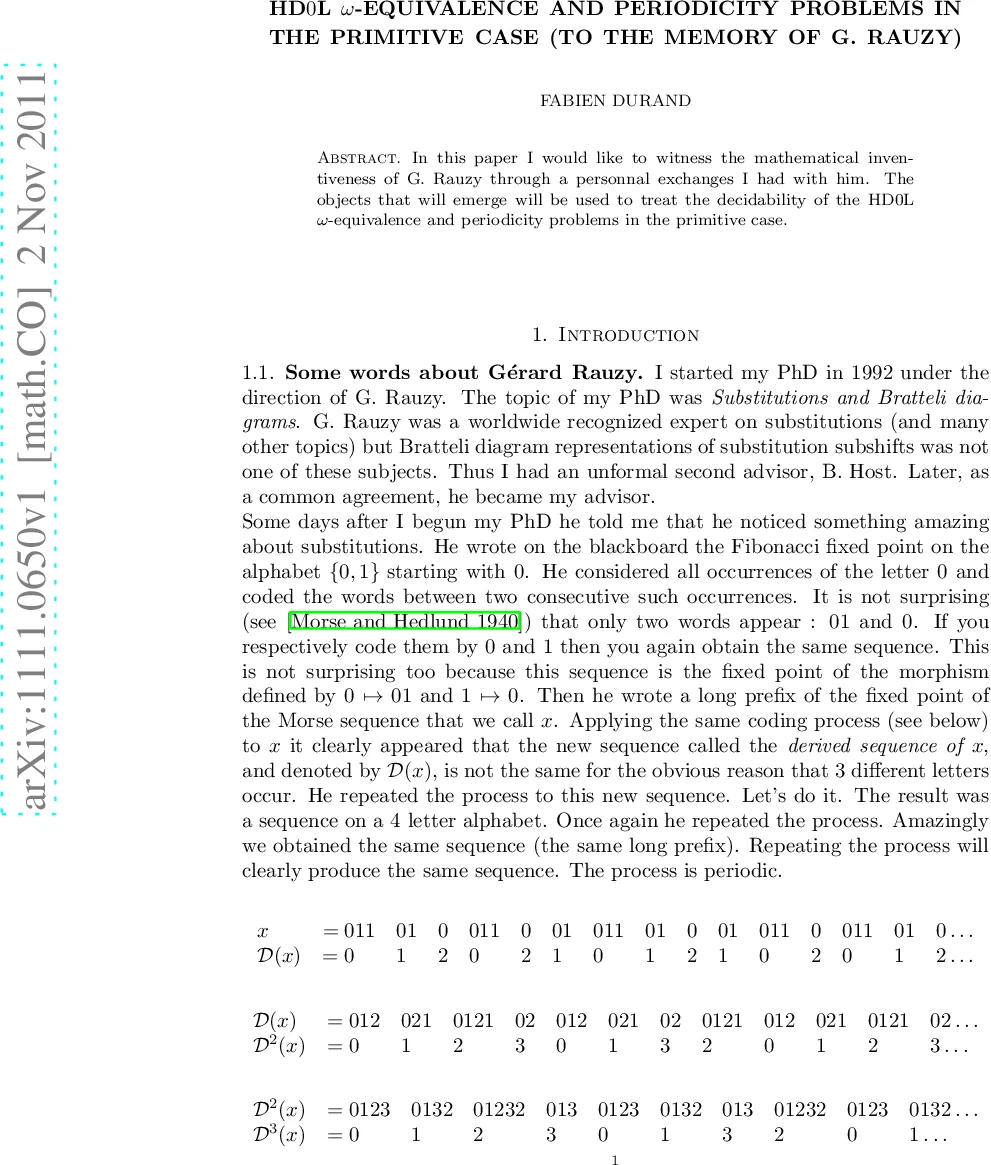
In this paper I would like to witness the mathematical inventiveness of G. Rauzy through personnal exchanges I had with him. The objects that will emerge will be used to treat the decidability of the HD 0 L $\omega$-equivalence and periodicity problems in the primitive case.
💡 Research Summary
The paper, dedicated to the memory of G. Rauzy, investigates two long‑standing decision problems for infinite words generated by primitive substitutions: the HD0L ω‑equivalence problem and the ultimate periodicity problem. An HD0L system consists of a morphism (substitution) σ, a starting letter a, and a coding morphism φ; the infinite word produced is φ(σ^ω(a)). The ω‑equivalence problem asks whether two such HD0L words are identical, while the periodicity problem asks whether a given HD0L word is ultimately periodic. Both problems have been open for more than three decades in the general case.
The author builds on Rauzy’s insight that the “derived sequence” obtained by coding the return words of a uniformly recurrent word corresponds exactly to the induced dynamical system on a cylinder set. For a uniformly recurrent word x and a non‑empty prefix u, the set R_{x,u} of return words to u is finite; ordering these words yields a coding Θ_{x,u}: R_{x,u}^* → A^*. The derived sequence D_u(x) is the unique word over the alphabet R_{x,u} satisfying Θ_{x,u}(D_u(x)) = x. Crucially, when x is the fixed point of a primitive substitution σ, the derived sequence D_u(x) is itself the fixed point of a new primitive substitution σ_u, called the return substitution on u. Both σ_u and Θ_{x,u} are effectively computable.
To obtain algorithmic decidability, the paper establishes explicit quantitative bounds on the size of return word sets and on the lengths of return words. Let d be the size of the alphabet of σ and |σ| the maximal length of σ(a) over letters a. Lemma 5 (Horn & Johnson) guarantees a power k ≤ (d−1)d^d such that the primitive matrix M_σ^k has strictly positive entries. Using this, Lemma 6 bounds the maximal gap R_σ between successive occurrences of any word of length two in any fixed point of σ by 2|σ|(d−1)d^d. Lemma 7 introduces a constant Q_σ that controls the growth of σ^n, and the combined constant K_σ = Q_σ R_σ |σ| is used throughout.
Theorem 8 shows that for any non‑empty prefix u of a non‑periodic primitive fixed point x, every return word v satisfies K_σ·|u| ≤ |v| ≤ K_σ·|u|, and the cardinality of R_{x,u} is bounded by 4K_σ^3. Consequently, the set of all return substitutions of σ is finite and effectively bounded (Proposition 10). Moreover, for any coding φ, there exists a unique morphism λ_u such that φ ∘ Θ_{x,u} = Θ_{φ(x),φ(u)} ∘ λ_u, and the collection {λ_u} is also effectively bounded (Proposition 11).
Armed with these bounds, the author solves the HD0L ω‑equivalence problem for primitive substitutions. Define a global bound
K = 1 + ⌈(4K_σ)^3 |σ| K_σ^2⌉ + ⌈(4K_τ)^3 |τ| K_τ^2⌉
where σ and τ are the two primitive substitutions under consideration. For each n, let u_n be the prefix of x = σ^ω(a) of length (K_σ+1)n, and v_n the analogous prefix of y = τ^ω(b). Theorem 14 proves that x = y if and only if there exist indices n < m ≤ K such that u_n = v_n, u_m = v_m, the corresponding codings Θ_{x,u_n} and Θ_{y,v_n} coincide, the same holds for n = m, and the return substitutions σ_{u_n} = σ_{u_m} and τ_{v_n} = τ_{v_m}. Because K is computable from σ and τ, a finite exhaustive search over all pairs (n,m) ≤ K decides equality. This reduces the ω‑equivalence problem to a finite verification, establishing decidability in the primitive case.
The periodicity problem is tackled similarly. Pansiot (1986) proved that for D0L sequences (i.e., φ is the identity) ultimate periodicity is decidable. The paper extends this to HD0L sequences generated by primitive substitutions. Using the same return‑word framework, one shows that if φ(x) is ultimately periodic, then the period and preperiod lengths are bounded by functions of K_σ and the coding φ. Consequently, checking all prefixes up to a computable bound suffices to decide periodicity.
In summary, the paper provides a complete algorithmic solution to both the HD0L ω‑equivalence and the ultimate periodicity problems when the underlying substitutions are primitive. The key ingredients are: (1) the dynamical interpretation of derived sequences via return words, (2) effective computation of return substitutions and coding morphisms, and (3) explicit quantitative bounds that guarantee finiteness of the search space. These results not only settle long‑standing open questions in the primitive setting but also deepen the connection between symbolic dynamics, combinatorics on words, and algorithmic decidability.
Comments & Academic Discussion
Loading comments...
Leave a Comment